
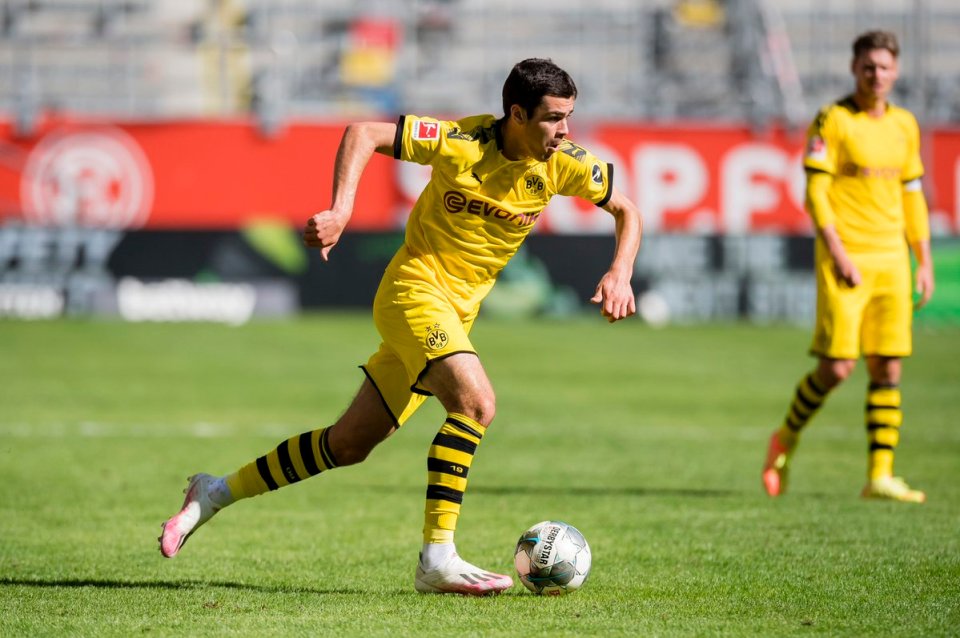
Round 33 of the 2019/20 German Bundesliga furnished plenty of intriguing notes for those tracking American players in Germany’s top-flight. Two significant firsts grab the most attention. As noted in the Bulletin, 20-year-old center-back Chris Richards made his Bundesliga debut for Bayern München. After a long wait, 17-year-old phenom Giovanni Reyna also earned his first start for Dortmund.
Reyna’s A-level performance is especially noteworthy, given that he currently angles for the starting spot Jadon Sancho is soon to vacate. Josh Sargent also showed a great deal for his team in the tight relegation race. Werner Bremen’s direct challenger for the relegation playoff spot, Fortuna Düsseldorf, did not use American Alfredo Morales in a 1-1 draw with Augsburg.
Richards’ introduction came far too late to warrant analysis. The remaining six Americans putting in time on the pitch all receive grades.
Giovanni Reyna- Borussia Dortmund
Minutes Played = 81, Positions Played = RW, LW, AM
Grade = A
Finally! I can’t be the only one who felt as if this wait stretched out for a seemingly infinite length of time. Thirteen relief appearances in the league. Two late substitutions in the UEFA Champions League and one in the DFB-Pokal. We even had to have our agony prolonged by an aborted start in the Bundesliga’s first game back from break. Argh.
Finally! Giovanni Reyna earns his first start. Here’s how it looked to me:
Lineup—Borussia Dortmund—(3-4-3)
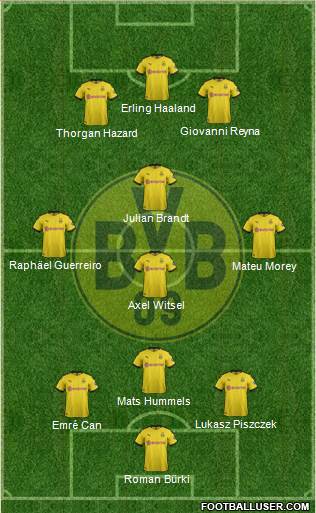
A genuinely brilliant setup borne out of necessity. Julian Brandt moved back to the midfield to pair vertically with Axel Witsel. Emré Can dropped all the way back to the fifth axis for stolid center-back work. Manuel Akanji’s injury allowed Lucien Favre to build in this way and it worked out murderously well. We get a nice glimpse of how the BVB might line up next season, even if Favre likely won’t be the coach.
Rotation on the top attacking axis was so intense that I was tempted to place Reyna in the 10 spot. On many forward charges, both he and Erling Haaland took turns stepping back in favor of Thorgan Hazard. Mateu Morey frequently bypassed both of them on many forward diagonals, though it’s unclear whether that was planned in any way.
There aren’t enough glowing words to describe the manner in which the top trio executed their rotation. They took control of the offensive flow early, reducing a talent-laden Leipzig side to the level of a sixth-tier bunch of potbellies. Dayot Upamecano, easily the most athletic center-back in the league, looked like Ali Bumayé trying to catch up with them.
If there was any criticism at all of the tightly grouped together forwards, it would be the fact that they didn’t implement the gameplan immediately. Brandt had Reyna through on the right already in the third minute, yet the American had to pump the brakes when Emil Forsberg caught up with him. Upamecano shut down Haaland central one minute later. Reyna, still on the right, mistimed a pass for Haaland in the seventh.
Reyna started sliding central in the 10th. Haaland took a little longer to start slanting left. Hazard folded over him shortly thereafter and the rotation was on. A whole slew of exciting chances preceded Haaland’s opening goal in the 30th. Reyna, in addition to getting a vital touch in the buildup, supplied the sublime assist. Very smooth stuff from the 17-year-old.
As the Dortmund domination continued, Julian Nagelsmann tried three separate tactical reformations. He even brought Dani Olmo on in the 39th as an early strategic sub. None of this adversely affected the fluid movement of the BVB. The on-pitch tactics used against Reyna were of the scurrilous variety. I’ve noted before that the young American invariably attracts a lot of cheap shots. I recorded three more hard fouls against him.
Reyna did earn his own booking in the 50th. He got a bit wrapped up into some end-to-end transitions occurring early in the second half. Perhaps over-psyched by other near setups of Morey and Haaland, there was some ill-discipline positioning. He eventually settled back down again and stuck with the straightforward rotative scheme. For much of the 10 minutes before he was subbed off in the 81st, he worked the left flank, rather well one might add.
The Haaland-Reyna bonding pieces keep coming. They’re working in tandem non-stop. I’m looking very much forward to seeing how those two combine both in Saturday’s finale and the coming campaign. Whosoever will be tasked with building tactics for the Schwarzgelben come September should keep Hazard, Haaland, and Reyna together upfront. Oh, how I wish Favre had given it a try five rounds earlier.
John Anthony Brooks- VfL Wolfsburg
Minutes Played = 90, Positions Played = CB
Grade = A-
The Berliner delivered a fairly decent comeback match. He bounced back from a recent form drop with solid, though not especially remarkable, play. So it goes for defenders sometimes. Merely getting the job done counts for a great deal, even if opponents like Schalke make it all too easy. I have this American winning 70 percent of his duels and only missing on five passes.
Some examples of strong defensive tackling can be found in the sixth, 13th, 22nd, 33rd, 61st, and 79th. He was guilty of an amateurish giveaway in the 74th, but that hardly negated all of his good work. Brooks handled most carries out of the back serviceably. He sparked plenty of sturdy attacks and regularly accomplished reliable triangulation with defensive partner Marin Pongracic and midfielder Maximillian Arnold.
Trainier Oliver Glasner built his set-piece positioning into the nifty trick that led to Kevin Mbabu’s goal in the 59th. Brooks functioned as the primary decoy in the play that let Daniel Ginczek slip through unmarked. He’ll likely figure into lots of this week’s training pitch designs as Glasner tries to manufacture some sort of advantage against Bayern in the campaign’s finale.
Josh Sargent- SV Werder Bremen
Minutes Played = 90, Positions Played = RS, RW
Grade = B
I observed enough spirit in the legs of the young Missouri marvel in Saturday’s loss to justify a B-level grade. A 1-3 scoreline against FSV Mainz 05 was a bit harsh for the Hanseaten. One must at least accord them credit for playing like a side facing relegation. They fought with a satisfactory amount of urgency. Even Florian Kohfeldt’s tactical plan made sound sense.
Lineup—SV Werder Bremen—(5-2-1-3)
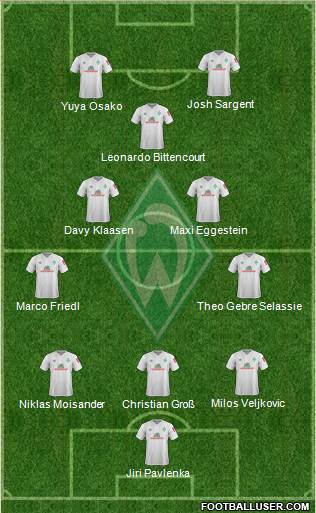
An injury Kevin Vogt placed the Werderaner at a serious disadvantage from the start. As if this team hadn’t already experienced enough devastatingly timed losses this season, the January acquisition had finally found his form and settled nicely into a pseudo pivot runner role. Tasking Christian Groß with this wasn’t ideal. One watched him closely in the early minutes. He attempted to work a midfield build in the third, then apparently gave up and sat on a flat back-three for the rest of the afternoon.
Sargent began with plenty of pep in his step. He only just missed Yuya Osako on a nice through ball in the first. Osako was able to serve him in a dangerous area following a fourth-minute throw-in. FSV Keeper Florian Müller had to be alert in saving the American’s impressive hard low shot. All the Bremen attackers got their looks in during an extraordinary early push. Sargent got another shot off during a flurry three minutes later. Osako and Leonardo Bittencourt were also in the mood, both missing within seconds of one another.
Vogt’s absence, combined with some lofty expectations conferred upon both wingbacks, left the back-three extremely vulnerable. Sargent recognizably stepped up his defensive game. Having tracked him all season, I’ve not seen him hustle back to help so much in any of his previous fixtures. He put a direct stop to two Mainz counters with quality tackles between the 18th and 21st. Set-piece defending was spectacular. The first half featured two imposing headers away -in the ninth and 36th- after well won aerial duels. It’s always a pleasure to watch him actually use his size and frame.
An obvious disadvantage of how Kohfeldt chose to stack the top attacking axis concerns the fact that the Mainzer would eventually find ways to close down the passing lanes. In many cases, Bittencourt, Osako, and Sargent were able to punch through but had no options for a final ball whenever the Nullfünfter collapsed their back four inward. Groß attempted to remedy this with both direct forward and outward possession pushes around the 20th. It was only a matter of time before Achim Beierlorzer’s counter would take advantage of the still more space this gifted them.
Jiri Pavlenka had to keep rushing out of his goal to keep Mainz at bay. Osako and Sargent did their part on trackbacks, but couldn’t stop Robin Quaison’s finish from barely crossing the line in the 25th. Midfielder Jean-Paul Boetius, in a ridiculous amount of space, doubled the advantage less than five minutes later. Some serious heroics from Pavelnka kept it going 0-3 or even 0-4 in the 36th and 37th. As the American’s team kept pressing through four minutes of first-half injury time, Sargent found himself either a step too early or too late on the Bremen attack. He couldn’t quite catch up to a Niklas Moisander in one case, got caught offside in another, and didn’t have enough stamina left to follow Davy Klaasen into the box at 45+2.
Lineup—SV Werder Bremen—46th Minute—(4-3-3)
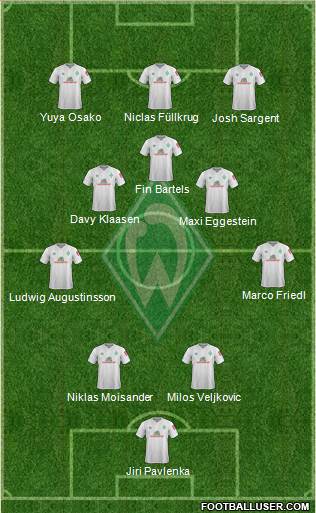
This served as quite the sight. An injury to Theodor Gebre Selassie shortly before the break forced Marco Friedl to switch over to the right. He got a couple of good crosses, nearly linking up with Sargent on one memorable occasion. Florian Kohfeldt needed to go all out, however. Enter the two players whose early injury woes forced Sargent into the starting XI way back at the beginning of the season. Niclas Füllkrug and Fin Bartels the fray in what was a fabulous final push.
Füllkrug and Bartels put together many slick combinations during a gripping attacking spell between the 48th and 58th. Füllkrug pulled off a nice first-time dropkick in the 53rd. As was the case in the first half, all of the crowded pressuring in and around the box made it a tad easier for the opposition to close down passing lanes. This didn’t stop Osako from tallying in the 59th after Füllkrug found Klaasen with a cheeky backheel and the Dutchmen quickly exploited a gap to service the Japanese international.
Sargent had a little trouble sorting his positioning out whilst surrounded by so many attackers. His defensive game still didn’t suffer. Back helping in several instances between the 66th and 71st, he ensured that the counter remained covered. A Klaasen ball for Bartels in the 72nd should have been shuffled on for him, but Daniel Brosinki managed to clear. The American got his third and fourth shots on target off in the 74th and 76th, respectively. The latter was a wicked effort that he was unlucky to see deflected wide.
I expect we’ll see something similar to the second half strategy when Werder faces Köln in the season’s final contest on Saturday. The recent play of Füllkrug and Bartels suggests that, while neither is fully fit, Kohfeldt will have to take a chance on starting them both. A lead needs to be procured without delay. Figuring prominently into this strategy shall be a young striker always in the mood for an early-match goal. The Bremen manager retains a racehorse with piston-like speed out of the gate. He knows where to turn for some prompt primacy. Oh, yes. This should be interesting indeed.
Weston McKennie- FC Schalke 04
Minutes Played = 90, Positions Played = CM, RM, AM, ATTM
Grade = B-
The Texan remained his side’s sole bright spot for long stretches in the latest defeat. Watching him play so well on such a deplorable team remains frustrating. Manager David Wagner deployed a carbon copy of the flaccid and uninventive 4-4-2 utilized in the two previous rounds. This time Michael Gregoritsch and Rabbi Matondo functioned as the strikers and Daniel Caligiuri returned to work on the right-wing.
McKennie’s first notable involvement came in 14th. A VfL offensive onslaught required him to stay on his toes and deflect a Josip Brekalo effort out into touch. The American would actually direct a couple of passes out of danger before the Wolves finally found the back of the net in the 16th. Schalke’s rather pathetic attempts to get their own engine into gear made for wince-inducing viewing.
One definitely can’t fault McKennie for this, however. He instigated an auspicious enough give-and-go with axial partner Alessandro Schöpf in the 19th. Inexcusably, the return ball missed by miles. Schalke’s potential future captain kept his nerve while his team degenerated into a sloppy, half-speed mess of egregious fouls. He provided the only impetus forward late in the first half, earning two free kicks in quick succession and testing keeper Koen Casteels from 15 meters out seconds before the break.
Wagner moved him into an anchoring position at the restart. A 4-2-1-3 pitted him directly behind Matondo, Gregortisch, and the subbed-on Benito Raman. A neat attacking sequence in the 50th saw the American get Timo Becker involved. Five minutes later, McKennie blazed up the pitch on a superb solo run. A dump off to Juan Miranda proved the wrong decision at the end of a sparkling individual effort.
Within a minute of this zenith moment, the American got caught flat-footed and overcommitted. VfL winger Renato Steffen charged through a completely empty midfield, ultimately setting up Wout Weghorst for the second goal. McKennie got booked for a hold on a play shortly thereafter. The Wolves used the ensuing free kick to open up a 3-0 lead in the 59th. One can’t dock either the USMNT star or the rest of his team much for wilting after that knockout blow. It’s a small miracle they even put together a few good plays down the stretch.
Tyler Adams- RasenBallSport Leipzig
Minutes Played = 45, Positions Played = RWB
Grade = C
Assuming I gleaned a proper read of Julian Nagelsmann’s second-half tactics in the 0-2 loss to Dortmund, I think Adams’ job was to work the overlap behind right midfielder Nordi Mukiele. While this American’s speed, touch, field vision, and even tackling prowess were on display in this one, I don’t think he handled the assignment particularly well.
Barely a third of his 45 touches were forward. He missed a chance to join in on some useful counters in the 55th and 67th. Some possession spells around the hour mark demonstrated alertness of the ball, but he didn’t have any real ideas of how to get out of his own half. BVB markers could all too easily dispossess him.
A late recovery saw him find a bit of creativity in the 70th, 85th, and 89th. It appeared that Nagelsmann allowed him greater leeway after the double substitution in the 70th. Whatever side one finds oneself on with respect to the Tyler Adams midfielder/defensive back wrangling, I think the high points in this fixture demonstrate that he should pair laterally with Jose Tasende (“Angelino”).
Timothy Chandler- Eintracht Frankfurt
Minutes Played = 63, Positions Played = RS, RW
Grade = D+
Adi Hütter placed this American right where one generally likes to see him. Somehow, the results just weren’t forthcoming this time. He might have been stretched a little too wide right on a crowded midfield axis that also featured Fillip Kostic, Djibril Sow, and Sebastian Rode. Other tactical miscues contributing to the 1-1 flop against Köln included positioning Lucas Torro directly ahead of Martin Hinteregger so that neither could run pivot or the desperation of the two striker set.
In any event, I can’t truly fall back on some familiar excuses here. Timmy had his fair share of self-induced problems here. Eight wayward passes, poor rearward cycling, a couple of blind throw-ins directly to the white-clad opposition, and some really poor touches on attacks in the first half demonstrated he didn’t have his mojo working on this particular day. A lovely acrobatic header forward in the 17th bucked the overall tepid trend of the afternoon.
A spade must be called a spade here. Chandler’s highly enjoyable revival needs to be qualified by the fact that he’s been prone to some pronounced form dips along the way. I find it doubtful that Hütter will start him in the season’s meaningless finale. Bit of a bummer to think of Timmy’s campaign ending this way.
Irrespective of how it ends for all of the US internationals in Germany’s top-flight, another season shall come to an end this Saturday. The time for on-pitch statements draws to a close. Some will swap teams. Some shall be on teams that swap leagues. Before having a chance to weigh in on any of that, eight active American players lace up for what may be their last chance for some time to speak with their feet.