
With five of its remaining nine rounds now completed, the 2019/20 German Bundesliga passed the halfway mark in its push to complete its interrupted season. While this hasn’t been the glorious summer of international football many of us had awaited, it will at least feature intriguing action in all of Europe’s major soccer leagues.
England, Spain, and Italy are set to follow the German lead soon. Portugal and many other countries already have. Even France may reverse course and possibly allow fans in for friendlies before July is out. The globe gradually exits its silent spring. If successfully completed fixtures from all 68 of the Bundesrepublik’s professional men’s and women’s football clubs this weekend are any indication, a full-scale sports relaunch should soon be possible almost everywhere.
Observational Aphorisms- Week 30
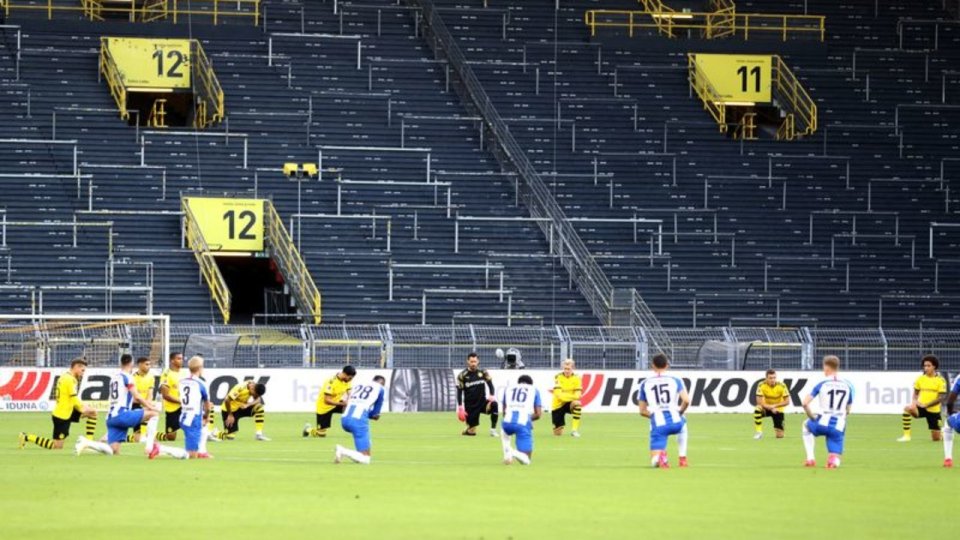
Not unexpectedly, ubiquitous anti-racist demonstrations serve as the lead story on the Bundesliga beat. Following the solidarity statements made by a handful of players in support of the George Floyd protest movement last week, more symbolic actions materialized across all of Germany’s professional football tiers. In scores of instances, starting players took a Colin Kaepernick-style knee prior to kickoff. “Black Lives Matter” armbands were out in force. Players of all ethnicities sported anti-racist warmup jerseys. Unable to attend the matches in person, many ultra societies and fan groups were able to design banners for display in the empty stands.
US internationals maintained an active role in the cause. FC Schalke 04’s Weston McKennie, ineligible to play in the weekend’s fixture due to yellow card accumulation, led the way with several impressive German-language media interviews throughout the week. McKennie cited his personal experience with common racial taunts like monkey chants as a reason for keeping this issue alive. Fortuna Düsseldorf’s Alfredo Morales took a knee prior to being substituted on in his sides fixture against TSG 1899 Hoffenheim.
I anticipate the Bundesliga, and indeed the Bundesrepublik itself, will find themselves on the receiving end of some backlash for this; accused of pedantically mingling in the affairs of a benefactor country benevolently responsible for our liberation and restructuring. There are also those who tire of this conversation, and, as such, shall be tempted to emphasize how far we’ve come and how grateful we should be for an improved status quo. After all, the world of sports now sanctions the expressive behavior that once destroyed the careers of players like NBA star Mahmoud Abdul-Rauf.
With respect to the interference charge, there does exist a regrettable sanctimonious strain in the European consciousness. Just as sure as there will always be racists, there will also always be those who perversely delight in judging others from a smug and self-satisfying distance. I’ll nevertheless argue that what we’ve been witnessing in the Bundesliga this weekend constitutes more of an internal activation than a pharisaical distance judgment from across the pond. European football already boasts strong anti-racist movements because they have a plethora of internal problems with it. It doesn’t take much to get that machine moving. Had the George Floyd incident not occurred, something else would have triggered it.
The fact that football enthusiasts find themselves locked in a perpetual fight with sectarian perspectives also addresses the question of discursive fatigue. Those who find themselves, even somewhat understandably, exhausted with the discussion must realize that football can likely never hope to arrive at what one might describe as a satisfactory destination. I cannot necessarily speak for other sports, but the most prolific international one remains in it for the long haul. A truly global game must confront global biases and prejudices. That’s why these movements must continue.
Recall the incidents from this autumn’s England vs. Bulgaria Euro qualifiers. There is zero chance attitudes like this will somehow cease all across the globe. Not in my lifetime. Not in yours. Perhaps long after we’ve all drawn our last breathes a utopian era in which the human species stops dividing itself by petty sub-classifications might emerge. Perhaps not. Our species is probably more likely to destroy itself before ever attaining such an ideal. Let the movements and messages continue.
Getting back to the football, SC Freiburg’s 1-0 over Borussia Mönchengladbach resurrects Breisgauer hopes for a UEFA Europa League qualifying spot. Impressive tactics from manager Christian Streich neutralized Marco Rose’s attacking trident until it was yet again time for the Bundesliga’s most accomplished joker, Nils Petersen, to come off the bench and score the game-winning goal. Pleased by the result, I remain a bit bummed about watching two consecutive Friday evening fixtures played before an empty Schwarzwaldstadion. It’s such a great atmosphere, particularly under the lights. Seeing as how Freiburg won’t even be able to play night games whenever they move to their new stadium, we need to ensure that the old Dreisam gets a proper send-off.
Bayer 04 Leverkusen’s Florian Wirtz claims the distinction of being the youngest ever Bundesliga player to score in a league fixture. The FC Köln youth academy product tallied late in his side’s 2-4 losing effort against table-toppers FC Bayern München. It came as quite the surprise to see the 17-year-old, who’s quiet January transfer to the Werkself-reserves slipped under everyone’s radar, get a spot on Peter Bosz’ starting XI in the first game back after the corona-break. It’s amazing how he utilized that time to fight his way into the team. For those interested, Borussia Dortmund’s American phenom Giovanni Reyna’s pursuit of this particular record now officially ends. Reyna is five months Wirtz’ senior. Oh well. At least we’ll always have that Pokal goal.
Bayern again exhibited no signs of fluster even after falling behind early in the Leverkusen match. It’s forgivable that some broadcasters entered the weekend proclaiming that the title race might be revived. The German giants faced Bayer this weekend and must play Gladbach next round. Hans Dieter Flick’s men actually lost to both teams in the reverse fixtures. Why couldn’t it happen again? Duh. Perhaps because Flick’s Bayern hasn’t lost any league, cup, or European games since that 14th round defeat to Gladbach. Bundesliga enthusiasts knew that the 2019/20 title race has been well and truly dead since the 28th round. Some stubborn souls still persist. Some say the suspensions of Thomas Müller and Robert Lewandowski give Gladbach a chance next week. Give it up, people, there’s always next season.
SC Paderborn 07’s 1-1 draw with RB Leipzig was definitely a fun one. Steffen Baumgart’s team struggled to keep themselves in the game even after the Dayot Upamecano sending off reduced Leipzig to 10 men for the entire second half. Paderborn keeper Leopold Zingerle made some heroic saves as his out-gunned squad conserved energy for a splendid late push. Christian Strohdiek’s last-second equalizer came at the end of a fantastic flurry of chances in the final six minutes. Well done, Jungs.
Of course, we can’t talk about Leipzig without touching upon Timo Werner’s all but confirmed impending transfer to Chelsea FC. It looks as if a deal is sealed for the grand total of €50 million. Wait a second. What? Only €50 million?! That’s about half what one might have expected Werner to go for prior to the COVID-19 advent. We football economics fiends still have a preponderance of unanswered questions concerning how the global pandemic will affect the markets. Many won’t be answered for years. This does count as a highly significant sign, however. Werner leaves Germany for a paltry price tag when compared with recent transfers like Luka Jovic, Christian Pulisic, Naby Keita, and Ousmane Dembele.
Not sure which result makes me angrier. Eintracht Frankfurt’s listless 0-2 defeat to FSV Mainz 05 or Fortuna Düsseldorf’s failure to do better against 10-man Hoffenheim than a 2-2 draw. Adi Hütter asked way too much of 36-year-old central defender Makoto Hasebe by starting him for the fourth consecutive match in less than 14 days. He could have moved a surging Stefan Ilsanker over to the central pivot position or even tapped Djibril Sow. Hütter’s idiotic use of Fillip Kostic on a ridiculously deep axis in the last three matches is only eclipsed by Uwe Rösler’s schizo-placement of Valon Berisha. The F95 manager has no reason to be so woefully inconsistent with his wingers. The latest 3-3-2-2 was just a joke. Why can’t he use one of his more coherent plans?
A loss for Frankfurt, in all likelihood, doesn’t pull them back into the relegation race. The midweek win over SV Werder Bremen was probably enough to put them on safe ground. I’ll stick 1. FC Köln to make it, even if this weekend’s draw with FC Augsburg counted as a monumental foul-up. Mainz’s win combined with Fortuna’s draw isn’t as consequential as one might think. The F95 remain only three points from safety and play two weak teams in the final two rounds. A 1-1 draw for 1. FC Union Berlin against hapless Schalke worries me the most; that team is imploding something fierce.
Arithmetically speaking, we still have an eight-team relegation contest. SV Werder Bremen’s 0-1 loss to VfL Wolfsburg still doesn’t conclusively doom them to automatic relegation. By contrast, Paderborn’s draw does nothing to lift them out of a sure last-place finish. Subtract Paderborn, Köln, and Frankfurt,. and it’s more like a five-club dead heat: Bremen, Düsseldorf, Mainz, Union Berlin, and Augsburg. Entertaining enough stuff for the last three weeks.
Weekly Tactical Focus- “The Classicist”
Bundesliga lovers hoping for a major upset this weekend were disappointed when Bruno Labbadia’s rising Hertha BSC couldn’t overcome the talent deficit to knock off Borussia Dortmund. Three points for die alte Dame would have livened up the race for the Europa League places. The capital club needed an improbable win to keep pace with clubs like VfL Wolfsburg and the disliked TSG Hoffenheim. It wasn’t to be.
While the end result may have been less than optimal, one can say that Labbadia’s system kept matters extremely close throughout this tightly contested match. His tactics nearly enabled the underdogs to pull it off. Before memories of his more masterful moves fade against the backdrop of Hertha’s final table position, we’ll accord them coverage here. As any reader can tell from my regular referencing, I’ve been meaning to get to a draw-up for some time.
Lineup—Hertha BSC—(4-2-3-1)
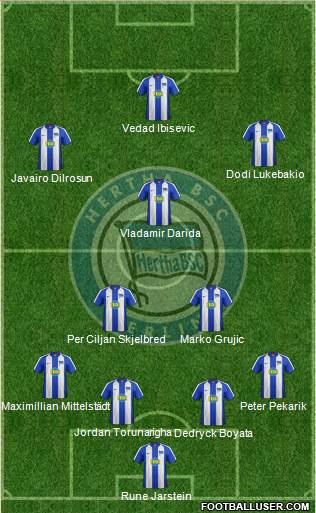
We’ll get to some compelling intricacies about this in a moment. First, we’ll need to spend time on personnel. Thirty-five-year-old captain Vedad Ibisevic spearheads this attack. This was most certainly not the plan under previous coaches Ante Covic, Jurgen Klinsmann, or Alexander Nouri. What early-season matches he did start for Covic saw him subbed off early. Klinsi left him out of the lineup for five straight rounds. Nouri mostly fiddled about with Matheus Cunha and Krzysztof Piatek when he wasn’t trying Dodi Lukebakio upfront.
Labbadia reintroduced his veteran captain, who quickly repaid his confidence with two goals and two assists in the opening two matches after the league returned from the break. Thirty-three-year-old Peter Pekarik had earned a delayed audition under Nouri. Labbadia evidently liked what he saw from this other veteran and stuck with him as his regular right back. Twenty-nine-year old Belgium international Dedryck Boyata received the defensive captaincy. Per Ciljan Skjelbred and Vladamir Darida, two experienced central midfielders of well advanced years were also cemented into regular roles.
Throwing a bunch of old pros into a straightforward 4-2-3-1 would be far too simple for most modern managers. This isn’t the sort of move that allows a trainer to get his very own special chapter in one of Tobias Escher’s next tactical tome. Most managers will go to extreme lengths to get some of the gushing reviews. Julian Nagelsmann often receives for one of his devilishly devised deceptions. Labbadia does a few subtle tricks buried in the illustration above. It’s still, for the most part, good old-fashioned common sense footballing.
We arrive at a more precise examination of how this works. Vladimir Darida seems an apt starting point. Labbadia structures an interesting 10-spot assignment for the 29-year-old Czech international. Darida covers three axes; serving as the nine on many breaks, dropping into the defensive midfield ranks whenever Ibisevic isn’t pocketed, and shield-dribbling if Dodi Lukebakio and Javairo Dilrosun push out wide. With all this ground to cover, it came as no surprise that he broke the league’s all-time record for distance covered in a single match against Augsburg last week. As if that weren’t enough, he broke his own record in this match.
Darida’s movement is closely related to the manner in which Skjelbred and Boyata appear to coordinate. The Belgian center-back has been a beast on defensive duels as of late. Whenever the defensive captain wins a ball, he calmly surveys the upfield chain. Forward carries are deliberately slowed down while Skjelbred keeps a close eye on the defensive chain. The Hertha 4-2-3-1 seeks out quick transition play about as much as any other similar constellation does. My eyes nevertheless discern an interesting layer of caution ostensibly meant to ensure that the squad still dominates the spatial game.
Here’s how Hertha looked during many stretches of the highly captivating first half.
Lineup—Hertha BSC—9th minute (5-2-3)
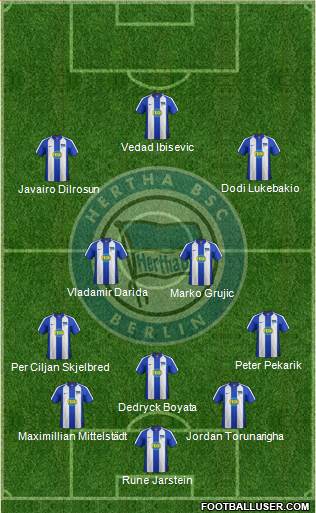
I’ve selected the ninth minute as it was the first time the shape featured. Other modified variations were on display during intervals such as the 15th-17th, 19th-21st, 25th-27th, and 35th-38th. The use of these contours ensured that Hertha never repeatedly squeezed the Dortmund strikers out of space. Lucien Favre’s 3-4-3 never got its rotative scheme established. Jadon Sancho, Julian Brandt, and Thorgan Hazard found no way though no matter how many times they switched sides.
Darida, Boyata, and most especially Skjelbred remained the key actors in this. Their fluid movement on the Hertha left squelched out anything the BVB could muster on the right whilst simultaneously opening up forward options via the highly mobile Darida. As noted above, Skjelbred would often fold in behind Boyata on carries. Marko Grujic dropped back with discipline as well while Darida searched for space. The uncomplicated strategy was easy enough to read, but Dortmund never came close to truly cracking it.
Brandt and Sancho were eventually able to setup Emré Can in the 57th on one of the rare occasions when the Schwarzgelben were able to carve out a sliver of space. After Piatek replaced Skjelbred in the 64th, tactical plans on both sides began to break down. Much of the second half was fairly ho-hum.
A grinding 1-0 win for the favorites may not have been satisfying for those looking forward to this fixture all week. I myself enjoyed watching the Berliners XI hold their own with a simple defensive strategy. Much as he did with previous clubs Wolfsburg and Hamburger SV, Labbadia builds an uncomplicated 4-2-3-1 that draws upon the tools possessed by specific when it reformats. The classicist innovates but doesn’t overdo it.
Weekly Wortschatz- “Härtefallantrag”
In this week’s linguistics segment, we’ll undertake the challenge of translating an entire letter. When news broke that financially-threatened Bundesliga club FC Schalke 04 sent out a communique asking its season ticket holders to submit for a “Härtefallantrag” (“hardship application”) in order to receive refunds for COVID-19-canceled matches, no one in German footballing circles could talk about much else. The insanely imbecilic move has also blown up English language media feeds.
What the hemorrhaging fuck? I should point out that most of us football fans are actually willing to make totally irrational personal sacrifices for the sake of our commercially irresponsible hometown clubs. We’ll support a surprising amount of stupidity in the interest of keeping an important part of our local community going. There will even be plenty of Gelsenkirchen citizens willing to deprive themselves of some desperately needed Euros in order to help the club spend millions on a crucial summer transfer. Scarcely believable, but true.
It’s best if we let this communique commentate itself. Here’s a link to the full letter in German. Here’s how it sounds in English:
“Dear Members,
The FC Schalke 04 is tremendously thrilled by the superb solidarity shown by its fans in the recent Coronavirus Pandemic. Through the collective action “#NurImWir”, all those separated from the club continue to support it through the current economic crisis. The S04 does not, by any means, take such an outpouring of support for granted. On the contrary, we consider it quite extraordinary.
You may redeem the remaining value of your season ticket on January 1st, 2022. If your personal circumstances render this unacceptable, you can naturally request a payment beforehand. In order to ensure that the FC Schalke 04 treats its association family uniformly and that we may deal with all hardship applications in a fair manner, we’ll need some additional information from you. Please fill out the following forms.”
A bunch of forms essentially mimicking the Hartz IV application are enclosed. An essay form prompts the applicant as follows:
“Why do you absolutely need the money now? Please justify your hardship claim on the lines below. If possible, please attach supporting documents”
Oh man… We’ve gone there. To highlight the most salient point, the club is withholding a minuscule refund to season ticket holders who missed FOUR home matches for 18 months. In order to claim what I’m sure can’t be more than €100, you must be prepared to spill your sob story and maybe even run off copies of your bank statement.
I must reiterate that, once the language gets softened, some fans will be perfectly okay with this. Germans have actually still been buying symbolic tickets for matches they can’t attend throughout this pandemic. I may or may not have been one of those who bought Geisterspiel tickets for the recent third-division clash against 1860 München and FC Kaiserslautern.
Yes, football’s just that important. Bill Shankly may have been famously quoted out of context, but that doesn’t mean millions don’t live it so.