
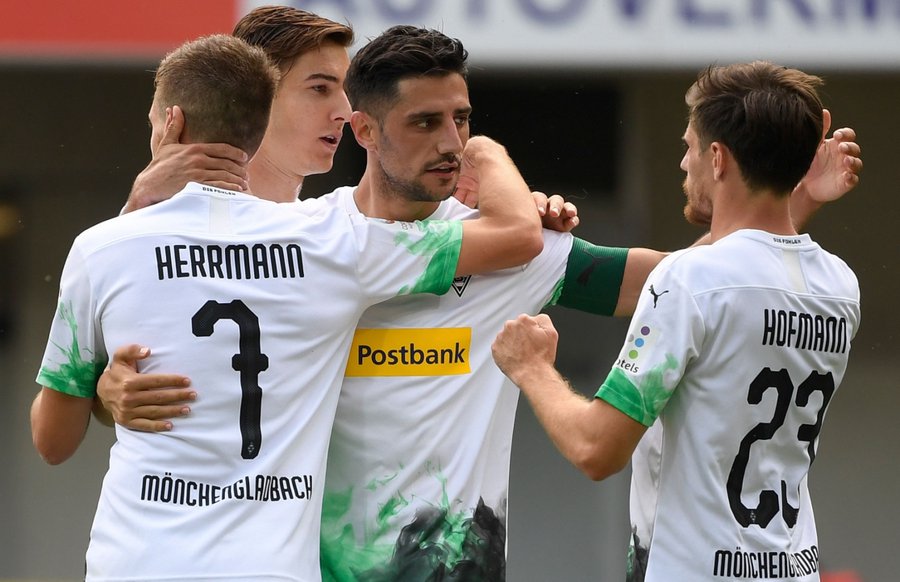
With glasses raised and fists in the air, the entirely of the German football-loving public exulted in nine simultaneous kickoffs all across the Bundesrepublik on Saturday. In the modern age of football fixtures spaced out to capture maximum television revenue, it’s always a treat to have two rounds a year preserve this tradition.
Saturday. 1530 in central Europe. Everyone kicks off at the same time. Just like the old days.
Much became clear at the finish of the 2019/20 campaign’s penultimate round. Seven clubs formally seized European tournament berths and four organizations were able to properly secure survival. Hertha BSC’s 2-0 upset of Bayer 04 Leverkusen renders the quest for the final UEFA Champions League place rather interesting.
In the relegation fight, Werder Bremen’s 1-3 loss to FSV Mainz 05 leaves them two points below Fortuna Düsseldorf, who earned another point in a 1-1 draw with FC Augsburg. Which team will be automatically relegated and which one lives on to fight in the playoffs will have to wait until next Saturday, when everyone kicks off at the same time again.
Observational Aphorisms- Week 33
As predicted, Bayern manager Hans Dieter Flick utilized his first fixture since clinching the title to make some exploratory personnel moves. Much to my personal chagrin, SC Freiburg couldn’t avail themselves of the opportunity. One of my more quixotic auguries fails. Drat. There remain some interesting moves to discuss. Javi Martinez started for the fist time since the 17th round, working as a direct center-back for the first time in nearly two years. Third-string keeper Sven Ulreich, who will surely be one of the coming transfer market’s hottest commodities, got a showcase-start. One of last summer’s developmental transfers, Michaël Cuisance, earned a trial at attacking winger.
Flick recently activated six players from the FC Bayern II reserve squad for possible use in the season’s final contests. Sarpreet Singh, who some may recall piqued interest earlier in the year when Niko Kovac elevated him to the Champions League squad, finally got around to making his bit of history. The 21-year-old became the first player of Indian descent to start for a European club team since Vikash Dhorasoo. Seventeen-year-old English prospect Jamal Musiala also made his first-team debut in this one. Third division super performers whom we may see start in the next week’s finale include Leon Dajaku and Kwasi Okyere-Wriedt.
As if all of this isn’t enough to ponder, we have a brand new US international to introduce. Center-back Chris Richards entered in the 84th to mark his Bundesliga debut. Bayern snatched the 20-year-old American out of the FC Dallas youth academy, Weston McKennie’s old stomping ground, 18 months ago. While USMNT head coach Gregg Berhalter hasn’t tapped the youngster for his first senior cap just yet, one has a sense that he’ll receive a call-up soon. Richards has had a breakthrough year for 3. Liga table-toppers Bayern II, starting 27 matches and scoring four goals. Elite English and Spanish clubs are beginning to express interest. Stay tuned.
Achim Beierlorzer and Mainz have pulled it off. With their third win in four matches since many a commentator selected them as one of the league’s most threatened teams, the Nullfünfter ensured an 11th consecutive season of top-flight football for the Rhineland-Palatinate. Now seems as apt a time as any to point out that my often dire predictions with respect to this club have nothing to do with the fact that Mainz is the fierce regional rivals of my hometown club FC Kaiserslautern. I’m not one of those Pfälzer who regularly shouts “Scheiß 05!” Okay… maybe I was once upon a time, but we were all young at some point. Congratulations to this town and team on assuring that the Pfalz retains Bundesliga representation. We’ll see you in about six years.
The celebrations were also on in Cologne as a 1-1 draw with Eintracht Frankfurt proved enough to ensure that the just-promoted Geißböcke will remain in the league. The intertwined stories of Mainz and 1. FC Köln continued to intrigue throughout the course of this campaign. Both clubs fired their managers on November 9 in an effort to avoid relegation. Mainz picked up the terminated Beierlorzer from Köln within a week. With one of the clubs apparently destined to drop, few of us Germans could resist speculating, then re-speculating, which organization made the major mistake. Both survived in the end.
Markus Gisdol deserves an immense amount of credit for engineering the Kölner turnaround. His selective promotion from the youth ranks made an immense difference early on. While the like Noah Katterbach, Ismail Jakobs, and Jan Thielmann did fade a bit down the stretch, they helped the squad pick up valuable points when it mattered most. I also think Gisdol’s January transfer window remains a strong contender for the campaign’s best. Mark Uth, Toni Leistner, and Elvis Rexhbecaj all fit into the schema nicely. Uth’s five goals for his hometown club were crucial. Obviously, Borussia Dortmund acquisition of Erling Haaland and even Leverkusen’s snag of Edmond Tapsoba will receive more attention. Uth may remain more influential in that he directly saved a club.
Citizens of two other German municipalities rejoiced in the full confirmation that top-tier football will return when they do next Autumn. Augsburg and Berlin’s Eastern quarter get another Bundesliga season on September 11, 2020. A Story about FC Augsburg that I honestly should have found a way to work in earlier concerns the unified and classy manner in which their full team handled the Gehaltsverzicht (salary forbearance) issue over the corona break. I briefly touched upon how well Union Berlin stood strong with the same issue when referencing Sebastien Polter’s expulsion from the team. I nevertheless didn’t come anywhere near to touching a very deserving topic.
Others have done such a spectacular job of documenting how various teams opted to deal with collecting weekly wages for unplayed football over the two months of lockdown. In German professional football, each club handled it differently. In the case of both Augsburg and Union Berlin, the players took the initiative to agree to unanimous and universally applicable pay cuts. The squads deserve to stay in the league fo that act alone. Care to know which Bundesliga club handled salary reductions the worst? Probably the over-leveraged Schalke 04. No, they can do nothing right this year. All of 2020 has been constant karmic punishment for chairman Clemens Tönnies’ early-season stupidity.
Unfortunately, regarding Schalke’s horrible news, we’re not quite done yet. The 1-4 defeat to VfL Wolfsburg extend’s the club’s winless run to 14 straight fixtures. In fact, the only time they even won during the entire second half of the season was in the 18th round. Entering the winter break, this time was in fifth place on 30 points. One win and six draws means they’ve only been able to accumulate nine points over the campaign’s second half. The lone player showing consistent attacking intent during the latest loss, Daniel Caligiuri, is about to get snatched up by Augsburg. It pours in Gelsenkirchen. Of course, this had to be the week of a COVID outbreak in the Tönnies meat packing plant. Of course!
The Wolfsburg win, the Freiburg loss, and TSG 1899 Hoffenheim’s 4-0 dismantling of FC Union Berlin leave next year’s Europa League picture set. Oliver Glasner’s Wolves and Dietmar Hopp’s vanity project will join either Borussia Mönchengladbach or Bayer 04 Leverkusen in next season’s second-tier European club competition. This wasn’t exactly the outcome most Germans were hoping for. Freiburg, Frankfurt, and Hertha BSC were the sentimental picks.
German ultras have unfinished business with Hopp. I’m not sure we’re ready to root for his a club as one of our country’s representatives yet. We’re always ready to root for green-company-team VfL Wolfsburg. One problem is that their own fans often aren’t. We didn’t need a global pandemic to ensure that the Volkswagen Arena didn’t exceed one-third capacity for the Europa League fixtures. That would have happened anyway.
Weekly Tactical Focus- Final Fight
The seven Bundesliga clubs qualifying for Europe are decided. Within this bracket, one final internal battle awaits. Will it be Leverkusen or Gladbach who claims the final Champions League place? Gladbach seeks to return to the grander stage for the first time since the 2016/17 campaign. Leverkusen themselves returned to the higher echelon competition this year following a three-year absence and do not wish to slide back.
This very same battle came down to the season’s final day last year. The two clubs entered the 34th round of the 2018/19 Bundesliga tied on 55 points. Gladbach dropped a heartbreaker to Borussia Dortmund 0-2 while Leverkusen blew out Hertha BSC 5-1. This time it will be the foals’ turn to finish against Hertha. Peter Bosz and the boys square off against Mainz.
My recent tip on this race assumed that die Werkself would capture maximum points from their remaining two fixtures. As we saw in the 0-2 loss to Hertha, that did not occur. It’s now Gladbach’s race to lose. They head into the 2019/20 Bundesliga’s grand finale with 62 points to Leverkusen’s 60. Marco Rose’s team fully control their own destiny, yet won’t have it easy against Bruno Labbadia’s resurgent capital club.
These two teams recently met head-to-head in what was actually, in my opinion anyway, the most entertaining league fixture of all the post-corona games. The beauty of the season’s final day is that Leverkusen’s win and far superb form in the second half doesn’t matter. Cumulative results from the entire season matter. All the early electrifying stuff from Gladbach and the putrid garbage supplied by Bosz still count for something all these months later.
Let’s see where these two teams are at.
Lineup—Borussia Mönchengladbach—(4-2-3-1)
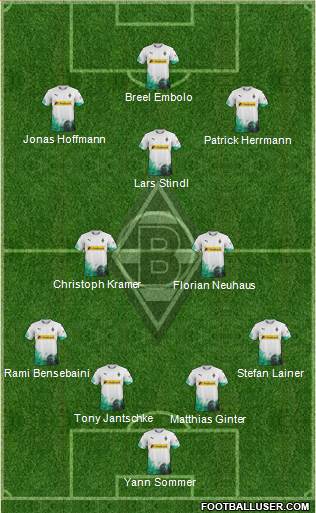
Three changes didn’t lead to any significant spacial alterations in the 4-2-3-1 from last round. If anything, it looked to me as if sixes Christoph Kramer and Florian Neuhaus were withdrawn a bit more. Counterintuitively enough, Rami Bensebaini’s return led to no changes in the defensive constellation. After Patrick Hermann stabbed home that early rebound, the Foals sat back and allowed opponents SC Paderborn considerable possession in space from the sixth to about the 16th minute.
Rose’s XI was slow and subtle about regaining control of the match. Lars Stindl and Breel Embolo only gradually began to move forward to contest more midfield balls. Jonas Hoffman, that tomahawk of a free kick in the 15th notwithstanding, wasn’t engaging in anything attack-minded; not even positional rotations with his axial partner.
The tenor began to significantly shift around the 17th, with the two sixes stepping forward. Offensive chances followed in a nifty spurt between the 21st and 25th. One did begin to see the limits of playing Embolo as a nine. Hoffmann and Hermann had him through on a couple of occasions but lacked the finishing flair of Alassane Plea or Marcus Thuram. Stefan Lainer had him set up as well in the 34th.
Embolo’s less than average awareness and touch was one matter of concern. There were also some long spells during which, with a shocking lack of intensity, the BMG midfield allowed Paderborn to leisurely pass their way out of dangerous situations. Bensebaini had an awful first half, punctuated by that clumsy track-back foul in the 42nd.
Rose obviously injected his side with some fire at the break. Hoffmann, Herrmann, Kramer, and Neuhaus pressed like mad after emerging from the tunnel. This led to some attractive attacking chances, along with a Paderborn equalizer when Sven Michel and Dennis Srbeny combined on a counter in the 54th. Lars Stindl charged back the other way like a poked bear, drawing and converting penalty less than a minute later.
There wasn’t much competitive football after that. The perpetrator of the foul, Uwe Hünemeier, got sent off on double yellows less than ten minutes later and Stindl completed a brace against reduced Paderborn in the 73rd. Gladbach’s actors were pretty much free to do as they pleased henceforth.
Before addressing some of the concerns, we’ll take a look at Leverkusen:
Lineup—Bayer 04 Leverkusen—(4-2-3-1)
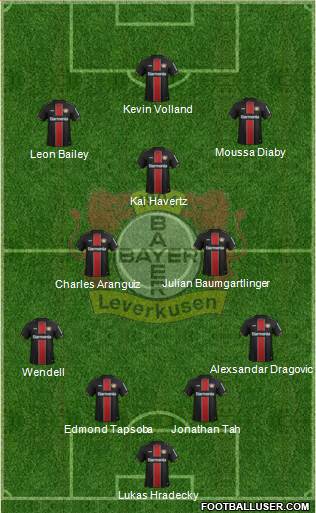
With Jonathan Tah replacing the more mobile Sven Bender, Bosz reverted to a more traditional 4-2-3-1. I personally found the 4-5-1 deployed in the previous round a much more promising system for possession builds. It ultimately didn’t matter much as die Werkself dominated the early flow. Labbadia’s own 4-2-3-1 couldn’t hold against the pace trio of Kai Havertz, Moussa Diaby, and Leon Bailey.
Niklas Stark kept getting pulled out of position, eventually forcing Hertha into a five-back set. Havertz had some early looks from diverse positions within the danger area. Diaby and Bailey rotated well, confusing, torching, and even briefly injuring Matheus Cunha on the right flank. The wingers got in nice square balls for Volland in the sixth, 13th, and 15th.
Cunha and Hertha recovered to score against the run-of-play in the 22nd. Dodi Lukebakio’s cutback for the Brazilian was indeed nice, but it still wouldn’t have been considered a genuine goalscoring opportunity had Cunha not out-deked Edmond Tapsoba and rifled off an improbably gorgeous finish. Suddenly, everything shifted. Cunha improbably failed to convert an easier chance three minutes later.
Though the trademark quick-passing Bosz possession game still had its moments, Labbadia’s XI broke up their wide play and took back control of the flanks. Out-swinger Diaby got one more effort in before the half was out, but otherwise, the best play belonged to die alte Dame. The once again itinerant Vladimir Darida was able to quickly suppress players from all axes attempting to fan out.
In a move somewhat reminiscent of his overreaction in the 28th round, the Leverkusen trainer employed two second-half substations. Kerem Demirbay and Paulo Henrique Sampaio “Paulinho” Filho came on for Volland and Aranguiz. Havertz moved forward to pair with Paulinho in what looked a bit like one of Julian Nagelsmann’s 4-2-2-2s. It was about as barefaced a pursuit of a power upgrade as it gets.
We got about eight minutes of engaging possession-based football before Hertha punched through on the counter. Cunha evidently took some of the early bullyings personally as he whizzed past everyone and set Lukebakio up to double Hertha’s advantage in the 54th.
Bosz responded almost immediately by opting for still more power. He swapped defender Tapsoba for striker Lucas Alario within minutes. The new 4-3-3 almost worked. Havertz didn’t miss by much in the 61st and defender Jordan Torunarigha had to acrobatically clear an Alario header off the line in the 77th.
There were plenty of moments when it still looked as if Bayer would pull it off. Labbadia’s defenders put in some heroic work. Stark actually remained ahead of the defensive line for much of the rest of the match and put in some crucial tackles. Darida and Marko Grujic worked together well to step forward in tandem and disrupt passing in the final third.
To return to the question of which club will claim what Germans refer to as the final “Königsklasse place” next week, I think we’re looking at Gladbach through on goal differential. With the benefit of a full week’s rest, one expects Labbadia’s disciplined defensive corps to put in another stellar performance against Marco Rose’s 4-2-3-1.
Somehow one sees little separating Gladbach and Hertha. Looks like a draw there. I’d definitely tip Bosz’ high-octane offensive for a big win over a Mainz side with nothing left to play for. Die Werkself could win by as many as five or six goals. That won’t quite be enough to overcome Gladbach’s current plus-nine goal differential, however. It’s the Foals in a close, but not quite photo finish.
Weekly Wortschatz- “unbekanntes Land”
Ordinarily, the end-of-the-season answers virtually all questions. Not this year. Take the case of the European club tournament places. Do we know for certain that there will be only four Bundesliga teams playing in the Champions League next year? Most likely, but not really. UEFA still hasn’t decided how to deal with countries like France, Belgium, and Holland, who canceled their seasons. I’m already acting on the assumption that seventh place Bundesliga side won’t have to enter the Europa League qualifying tournament as usual. Germany may even get extra slots.
What about the transfer market? Don’t get me started. Talk to me in a couple of weeks. Football writers ordinarily love nothing more than losing themselves in big beautiful transfer pieces. July 1 always serves as one of the most important dates in a football lover’s calendar. Annual European player contracts expire on June 30. Negotiations carry on from the end of the season (in early May) through June until the big signing day.
Since the Bundesliga is the only league to have completed play before the original contracts run out, hundreds of German league players are going to flood the market whilst players in all the other countries operate on hastily cobbled together bridge deals, legally tenuous pacts, and even unwritten agreements. Oh, the headaches. Second-tier side VfL Bochum has already announced that they will part company with 10 players -one-third of their roster- after play concludes next Sunday. This is only the beginning of a weird and wild summer.
In so many different ways, we’re all headed for unbekanntes Land (undiscovered country). For those interested, I chose this idiom because the Germans don’t have an equivalent of “uncharted waters”. We just don’t. That’s what happens when a mostly landlocked country doesn’t develop a navy until the entire globe has been mapped. Along with the decimate debate, it’s one of my favorite linguistic factoids.